RV Tuning 101: Can You Tune a Class A Motorhome ECU, and What Does It Actually Improve?
A Class A motorhome hauling a towed car up a mountain grade at 45 mph, engine screaming, transmission hunting between gears, fuel gauge dropping by the mile. That’s the situation most Ford V10 and 7.3L motorhome owners describe when they call us. The factory ECU calibration was built to pass emissions testing and satisfy warranty-claim averages across millions of miles of flat highway driving. It was not built for 26,000-lb gross vehicle weights, 8% grades, or the specific air-fuel and timing demands of an owner who’s added a cold air intake or runs 87 octane because premium isn’t always available on the road.
Yes, you can tune a Class A motorhome ECU. The platforms that matter most to U.S. owners – the Ford 6.8L V10 and the 7.3L “Godzilla” gas V8 – are fully tunable, and the improvements are real and measurable. This post explains exactly what changes, what doesn’t, and what honest expectations look like for a heavy RV platform.
Key Takeaways
- Ford V10 (6.8L) and 7.3L Class A motorhome chassis ECUs are fully tunable using the same professional tools used on F-150 and Super Duty trucks.
- Real-world gains on RV platforms center on low-end torque and throttle response rather than peak horsepower – those are the numbers that matter when you’re moving 20,000+ lbs uphill.
- Fuel economy improvements of 1 to 2 MPG are common at steady highway cruise, which adds up fast when your baseline is 7 to 9 MPG.
- A custom tune does not void the chassis warranty by law under the Magnuson-Moss Warranty Act, though your dealer can still deny a claim if they prove the tune caused a specific failure.
- 5 Star Tuning ships email tunes and preloaded handheld tuners nationwide, so you don’t need to haul a 40-foot coach to Florence, SC – though in-shop dyno service is available for Carolina-area owners who want it.
What Does ‘ECU Tuning’ Mean for a Class A Motorhome?
The ECU (engine control unit) is the computer that governs every combustion event in your engine: air-fuel ratio, ignition timing, throttle response curves, transmission shift points, rev limits, and torque management. From the factory, Ford programs the PCM (powertrain control module – Ford’s term for the ECU) conservatively. That conservatism has legitimate reasons: fuel grade variability across 50 states, emissions compliance across multiple regulatory regions, and liability management for a platform that will see wildly different use cases.
An ECU tune rewrites those parameters to match your actual vehicle, your actual fuel, and your actual load conditions. For a motorhome, the most impactful adjustments are usually ignition timing advance (more torque across the RPM band), torque management tables (removing software-imposed torque limits that cause the flat spots you feel when merging), and transmission shift scheduling (firmer, better-timed shifts that stop the hunting behavior on grades).
This is not a plug-in module that lies to your MAF sensor. A real ECU tune modifies the PCM’s calibration files directly, using professional software. At 5 Star, that means HP Tuners or SCT depending on the platform and model year – the same tools our tuners use on F-150 Raptors and Super Duty diesels, applied to your motorhome’s chassis. You can learn more about what ECU tuning involves at a foundational level on our ECU tuning explainer page.
Which Class A Motorhomes Can Actually Be Tuned?
The majority of Class A motorhomes sold in the United States since the mid-1990s run on Ford chassis, and the two engines that dominate that market are both tunable with current tooling.
Ford 6.8L V10 (Triton)
This engine powered the Ford F-Super Duty chassis used by Coachmen, Fleetwood, Winnebago, Holiday Rambler, Monaco, and dozens of other coach builders through the late 1990s and into the 2010s. It’s a 3-valve or 2-valve V10 with a proven long-term reliability record when maintained properly. The PCM on these units is tunable via SCT and HP Tuners hardware. We have dedicated calibration work for these platforms – our Ford V10 motorhome tune page covers the general platform, and if you’re running a 2016-era 6.8L specifically, see our 2016 6.8L V10 RV calibration page for model-year-specific details.
Ford 7.3L “Godzilla” V8
Ford introduced the 7.3L gas V8 in the 2020 Super Duty, and it quickly became the go-to engine for newer Class A motorhome builds requiring a big-displacement naturally aspirated gas option. These units have strong tune support through HP Tuners. If you have a newer Class A on this chassis, our 7.3L Class A motorhome tune page is the right starting point.
What About Other Chassis?
Workhorse W-series chassis (GM-based) are tunable in many configurations. Spartan and Freightliner-based Class A coaches running gas engines are tunable on a case-by-case basis. Diesel pusher motorhomes are a separate discussion – diesel ECU tuning involves different tooling, emissions complexity, and turbo calibration considerations. Contact us to discuss your specific setup before assuming we can or can’t help.
What Does an RV Tune Actually Improve? (Power, MPG, and Towing)
Honest answer: the gains on a motorhome chassis look different from a sports car tune, and they should. You’re not chasing a 0-60 number. You’re managing 20,000 to 26,000 lbs of vehicle and cargo across mountain passes, headwinds, and varying fuel quality. The improvements that matter are all in the low and mid-range.
Torque and Throttle Response
Most V10 owners report that the factory tune feels like it has a deliberate flat spot between 1,800 and 3,000 RPM. That’s the range where you’re trying to accelerate from a merge lane or maintain speed on a 5% grade. Removing the factory torque management tables and optimizing ignition timing in that band produces a noticeably stronger pull. Expect 15 to 30 lb-ft of additional torque at the wheels in real-world driving conditions – not peak dyno numbers, but usable torque where you actually need it.
Fuel Economy
This is the one that surprises people. A motorhome getting 7.5 MPG that improves to 9 MPG saves roughly $600 in fuel on a 5,000-mile trip at current gas prices. The tune achieves this by optimizing fuel trim tables and allowing the engine to operate more efficiently at steady cruise RPM. The gains are most pronounced at 60 to 65 mph highway cruise, which is exactly where most motorhome owners spend their time. A 1 to 2 MPG improvement is a realistic and honest expectation. We’re not promising double-digit fuel economy on a 40-foot coach.
Transmission Shift Quality
The TorqShift transmissions paired to these Ford engines have their own PCM-controlled shift logic. A tune can firm up converter lockup scheduling, reduce the gear-hunting behavior on moderate grades, and tighten shift timing so the transmission isn’t constantly searching for a gear. Motorhome owners consistently rate this as the most immediately noticeable improvement after a tune.
High-Altitude and Mountain Performance
Factory fuel and timing tables are calibrated for average conditions. At altitude, the engine loses density and the factory enrichment tables often compensate poorly. A well-built custom tune accounts for altitude correction more aggressively, which translates to less power loss when you’re crossing the Rockies or the Blue Ridge Parkway.
Is It Safe to Tune a Motorhome ECU? Reliability and Warranty Concerns
This is the question every motorhome owner asks first, and it deserves a direct answer rather than the vague reassurances you’ll find on most tuning sites.
The Reliability Question
A conservative, professionally developed tune does not accelerate engine wear. It does not push the engine beyond its mechanical limits. What it does is optimize the calibration within the engine’s design envelope – the same way Ford’s own engineers would if they were programming for your specific load, fuel, and use case instead of the entire production-volume average. We do not raise rev limits, we do not raise boost (there is no boost on a naturally aspirated V10 or 7.3L), and we do not chase peak power at the expense of drivability or longevity.
The 7.3L Godzilla V8, for reference, was engineered with significant mechanical headroom. Ford’s own performance division has extracted substantially more power from it with supercharger kits. A conservative naturally aspirated tune is, by comparison, a minor recalibration.
The Warranty Question
Under the Magnuson-Moss Warranty Act, a dealer cannot void your entire warranty simply because you installed an aftermarket tune. They would need to demonstrate that the tune specifically caused the failure being claimed. That said, every dealer interprets warranty claims differently, and if a catastrophic engine failure occurs shortly after a tune, you may face a claim dispute. The honest answer is: the legal protection exists, but real-world dealer interactions vary.
5 Star Tuning addresses this directly: we offer an optional third-party powertrain warranty that covers tuned vehicles. It’s a meaningful protection layer for motorhome owners who are running significant miles and don’t want to self-insure a major drivetrain repair. Details are on our warranty-covered tunes page.
How 5 Star Tuning’s Class A Motorhome Tune Works: Step by Step
We’ve been doing this since 2004. The process for a motorhome tune is straightforward, and you don’t need to haul your coach to South Carolina to get one done.
Step 1: Request and Intake
Submit a tune request through our site and provide your vehicle details: year, engine, chassis type, current modification list (intakes, exhaust, anything that changes airflow), and what you’re trying to solve. Be specific about whether mountain performance, fuel economy, or transmission behavior is your primary concern. Our tuners read every intake form personally.
Step 2: File Development
Your tune is written from scratch for your vehicle and modification list. We do not pull a canned file off a shelf and email it to you. The calibration accounts for your actual mods, your target use case, and the known characteristics of your specific engine family. This is the part that separates a custom tune from a generic downloaded map.
Step 3: Delivery
For most Class A motorhome owners, we deliver an email tune loaded onto an SCT or HP Tuners handheld device that ships to your door. You connect the device to your OBD-II port (every Ford chassis post-1996 has one), follow the on-screen prompts, and the new calibration is written to your PCM in under 10 minutes. You can return to stock the same way if you ever need dealer service. Nationwide shipping means your location doesn’t matter. Browse our RV tuner options to see what’s available for your platform.
Step 4: Revision and Support
After you’ve driven with the new tune, we want feedback. If the shift timing is too firm for your preference, or if you want more low-end torque pull and less top-end optimization, we revise the file. You get direct phone access to the person who wrote your calibration, not a support ticket queue. Call us at +1 843-536-1244 if you want to talk through your setup before ordering.
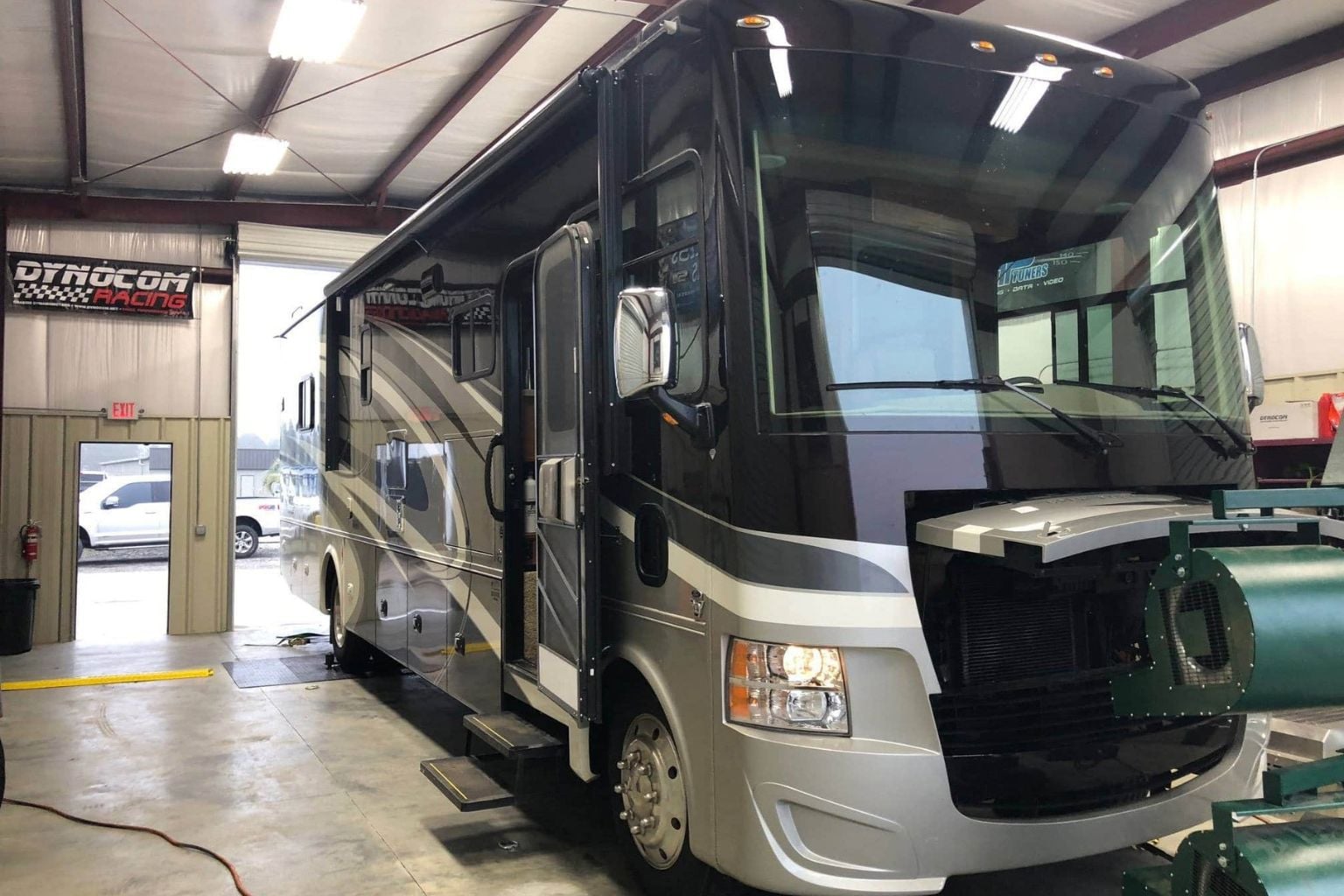
For motorhome owners in the Carolinas who want in-person dyno work, bring your coach to our shop at 1820 Trade St, Florence, SC 29501. We’ve had 40-foot Class As on our chassis dyno and we have the space and experience to handle them.
The Bottom Line
A Class A motorhome ECU tune is one of the highest-value modifications available for Ford V10 and 7.3L chassis owners. The improvements are real, the risks are manageable, and the process is simpler than most owners expect. If you’re tired of your coach hunting gears on every moderate grade, watching your fuel gauge drop, or feeling like the engine is working twice as hard as it should, a custom calibration is the right first step.
5 Star Tuning has specific tune programs for the Ford 6.8L V10 and 7.3L Class A motorhome platforms, backed by 20+ years of Ford-chassis calibration experience, 1,101 Google reviews averaging 4.7 stars, and an optional powertrain warranty that covers your investment. We’ve written calibrations for everything from daily-driver F-150s to 26,000-lb motorhomes, and we treat every file the same way: built for your vehicle, your mods, and your use case.
Get a custom tune for your Class A motorhome and stop leaving performance and fuel economy on the table.
Frequently Asked Questions
Can you tune a Ford V10 6.8L Class A motorhome?
Yes. The Ford 6.8L V10 Triton engine found in Class A motorhomes on Ford Super Duty chassis is fully tunable using HP Tuners and SCT hardware. 5 Star Tuning has dedicated calibration programs for both the general V10 platform and specific model years. The tune addresses ignition timing, fuel trim tables, torque management, and transmission shift scheduling – the parameters that most affect real-world motorhome performance.
Will tuning my RV void the chassis warranty?
Not automatically. Under the Magnuson-Moss Warranty Act, a dealer must prove the aftermarket tune caused a specific failure before denying a warranty claim on that basis. Your entire warranty cannot be voided simply because a tune exists on the PCM. That said, dealers vary in how they handle claims, and 5 Star offers an optional third-party powertrain warranty for tuned vehicles as an additional layer of protection.
How much horsepower and torque can I gain from an RV ECU tune?
On a naturally aspirated Ford V10 or 7.3L Class A motorhome, expect 15 to 30 lb-ft of additional usable torque in the 1,800 to 3,500 RPM range, with modest horsepower gains in the same band. Peak dyno numbers are less relevant here than low-end torque delivery, which is what determines hill-climbing ability and merge performance under full coach weight. We don’t inflate numbers – these are honest, real-world expectations.
Does an RV tune really improve fuel economy?
Yes, within realistic limits. Most Ford V10 motorhome owners see 1 to 2 MPG improvement at steady 60 to 65 mph highway cruise after a custom tune. On a 7.5 MPG baseline over 5,000 miles of travel, that’s a meaningful dollar savings. The gains come from optimized fuel trim tables and more efficient cruise calibration, not from magic. Results vary based on load, terrain, and driving habits.
Do I need to bring my motorhome in, or can I get a remote email tune?
You do not need to bring your motorhome to our shop. 5 Star Tuning ships preloaded handheld tuners and email tune files nationwide. The tuner connects to your OBD-II port and flashes the new calibration in under 10 minutes. For Class A owners in the Carolinas who prefer in-person dyno service, our Florence, SC facility at 1820 Trade St can accommodate full-size coaches. Call us at +1 843-536-1244 to discuss your specific chassis before ordering.